Assess powered movement, contact sounds and vibration massage separately. Compare the same model, mattress, support, listening position and movement, and involve both intended users. A quiet showroom demonstration does not guarantee inaudible bedroom use; decibel figures without test conditions are not directly comparable.
Separate the possible sources
Observe powered movement, sounds associated with moving on the mattress or contact with the furniture, and any sound during vibration massage separately. A sound alone does not establish motor failure, and every sound should not be assumed normal.
Furniture contact, support and room acoustics can affect what is heard. Another manufacturer’s documentation helps explain why these conditions matter; it does not establish a DEPY model’s noise performance.
Keep comparison conditions consistent
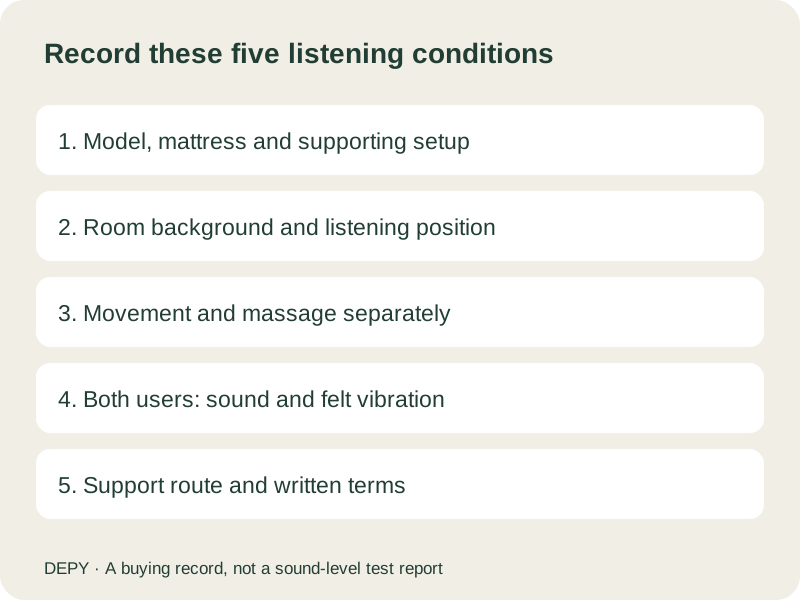
Record the full model, mattress and surround, support arrangement, listening position and background sound. With compatibility and operation confirmed by the seller and manual, compare the same movements from similar positions. Note differences in setup rather than treating unlike trials as equivalent.
First switch vibration massage off and try the back and leg adjustments you need. If massage is fitted, assess it separately. Do not mix massage sound with movement-only sound, overload the bed or run it continuously for a noise test.
Hypothetical example: a buyer hears a hum and assumes it is the lift motor; the demonstration also has massage switched on. The next step is to demonstrate functions separately and identify when the sound occurs, not conclude that every product is fault-free. This is not a customer report.
Listen together and account for the bedroom
Showroom music, conversation and room size differ from a quiet bedroom. Ask the other user to listen from their normal resting position and record sound separately from vibration felt through the bed. Your own tolerance does not establish your partner’s.
Second hypothetical example: a sound seems unobtrusive in a showroom but becomes more noticeable during a quiet period at home. Before buying, ask about the actual setup, installation conditions and support procedure for sound concerns. A bedroom need not reproduce a showroom.
Read sound figures with their test conditions
Ask about measurement distance, background sound, load and mattress, movement and whether the report covers the model being purchased. A phone recording may help support staff understand when a sound occurs; a single recording or phone-app value is not a professional cross-product noise comparison.
No untested DEPY decibel figure or zero-noise promise is made here. An integrated mattress cannot be declared quieter than all separate bases solely from its product format.
Record concerns and contact support
If scraping, knocking, stuttering or a sound clearly different from the demonstration appears, stop adjustment and follow the manual’s support route. Do not enter the moving mechanism, dismantle motors or add lubricant yourself. Support staff should inspect the actual setup rather than dismiss every concern as normal.
Record the model and pairing, room and listening position, individual functions tried, both users’ impressions, support contact and written terms. Confirm trial and return policies for base and mattress separately; dissatisfaction with sound does not automatically mean an unconditional return.
Prepared by DEPY. Asking when and under what conditions a sound occurs is more useful than asking only whether a bed is silent.
Source and related guides
Source: Ergomotion Europe FAQ on operating sound, room environment and massage sound (https://eu.ergomotion.com/faq), archived 12 October and reviewed 19 October 2026. Its guidance concerns its own products; this guide uses it to frame buying questions, not to transfer specifications, normal-sound judgments, repair procedures or warranty promises to DEPY.