Not necessarily. Raising the back can change your position relative to the nightstand. Reach depends on the exact movement path, mattress and bed height, furniture placement and the person using the bed. Fitting into the bedroom does not establish that the adjusted setup will be convenient. Try reaching with the intended configuration and confirm the space required throughout its movement with the supplier.
Try reaching, as well as measuring
The nightstand may be beside your hand while the mattress is flat, but raising the back changes the position of your shoulders and hands. Some mechanisms also move forwards or backwards during articulation. The names “smart bed” and “adjustable bed” do not specify that motion, and one brand's wall-positioning mechanism cannot be assumed standard across products.
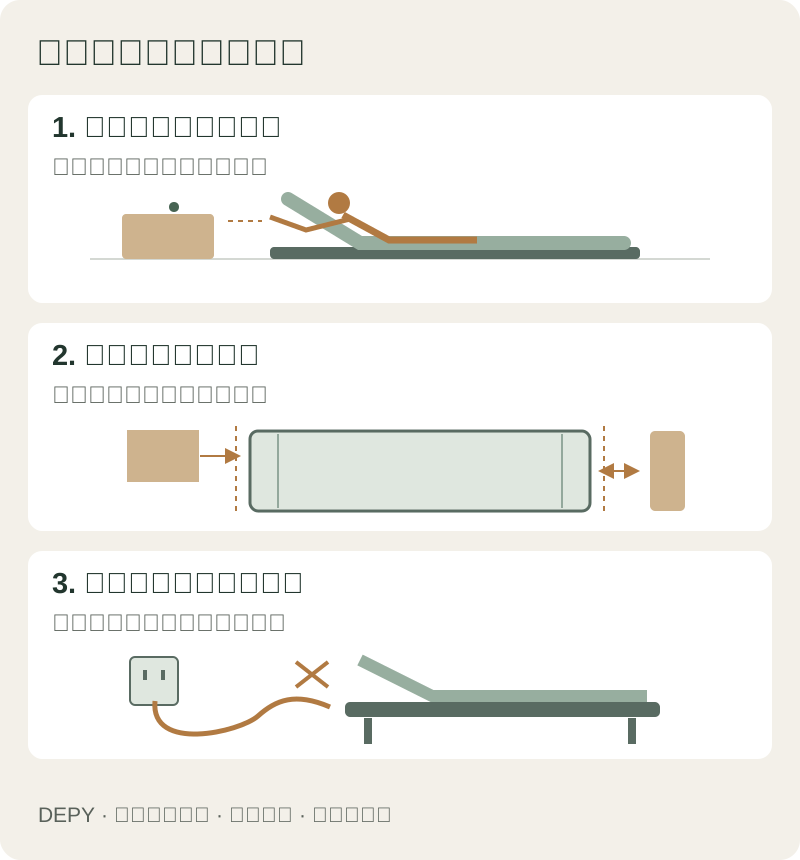
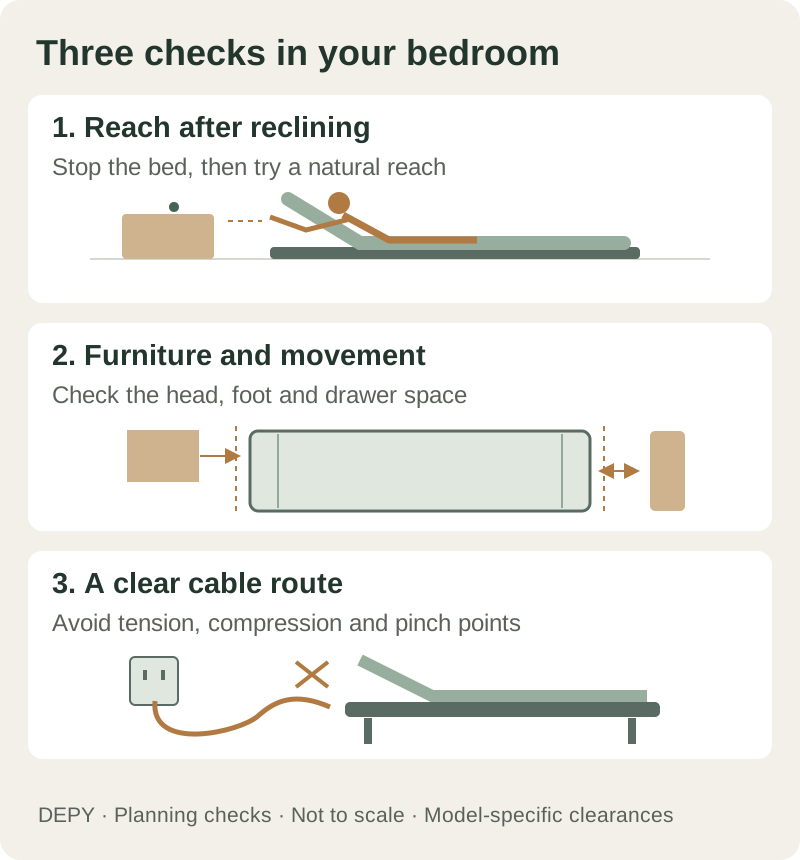
Record the cabinet's position, top height and where everyday items sit. Have the intended user try the proposed base and mattress combination both flat and in a usual reclining position. Once movement has stopped, try reaching naturally for a remote or glasses case. If this requires twisting, excessive stretching or leaning beyond the bed edge, reconsider the cabinet position or product pairing. Do not use a hot drink as the test object.
Check four areas throughout movement
- At the head: consider the wall, headboard, projecting plugs and moving sections. A photo of the bed lying flat cannot establish that it may be installed against a wall.
- At the foot: include the footboard, bench and wardrobe doors. Confirm the space required as the leg section rises and returns.
- Along the sides: check drawers, cabinet doors, access to the bed and bedding. A drawer that opens when the bed is flat may still need checking in other intended positions.
- Along cable routes: have the installer follow the model's instructions for power and control connections, avoiding tension, compression and pinch points throughout the permitted travel. Do not improvise by fastening cables to moving mechanisms.
This guide gives no universal wall gap. Required clearances, support, cable routing and service access must be confirmed against the exact model's instructions. Do not reach into moving gaps to inspect them, or keep operating a bed that contacts furniture or pulls on a cable.
Three bedroom-planning situations
Flat-bed reach is easy; reclining requires a twist
Suppose a buyer wants to retain a tall nightstand. Instead of checking only the maximum back angle, bring the cabinet height and position to the showroom and assess reach for a remote or glasses case with the actual pairing. Reposition movable furniture first. If a corner or wardrobe prevents moving it, ask the supplier to evaluate that constraint.
The bed fits, but a drawer or bench gets in the way
Suppose the furniture in a small bedroom just fits around the bed's outer dimensions. Record drawer-opening space, the foot bench and access paths as well as the empty bed footprint. Follow the model's requirements when checking its full motion and everyday use after it stops. Rearrange movable furniture if needed; do not remove load-bearing frame parts to create room.
The outlet is behind the bed, with little space for the plug and cable
Suppose a headboard hides the outlet and the connected cable is no longer visible. Have the installer check the relative positions of the plug, cable and moving parts according to the instructions before carrying out the specified operation check. Recheck routing after moving the bed or replacing a nightstand. Do not alter the electrical system yourself. These hypothetical situations illustrate the buying checks.
A bedroom brief to send your supplier
Proposed model: ____. Mattress: ____. Existing frame's internal dimensions and support: ____. Nightstand height and position relative to the bed: ____. Photos show the wall/headboard, furniture at the foot and outlet location. Please confirm the full movement envelope, required clearances, cable routing, drawer and access space, and installation arrangement.
If a seller describes wall-positioning or similar features, ask which complete model offers them, how it actually moves and what wall or furniture clearances still apply. A feature name is not a substitute for a dimensional drawing or demonstration. Apply the same checks to DEPY: this guide does not establish any undocumented wall-positioning mechanism for a DEPY model.
Sources and further reading
The Leggett & Platt official FAQ describes how its different mechanisms affect nightstand reach; WallHugger® is that brand's terminology, not evidence of a DEPY feature. Pages 3 and 5 of its 13 Button Remote Control User Guide address sync-cable pinch points and contact between a bed and walls, nightstands or other objects. The FAQ was archived on 12 October 2026 and reviewed for this guide on 23 October; the relevant manual pages were checked for this article. These sources do not supply DEPY installation measurements or repair instructions. The room-planning checklist is editorial buying guidance.
Continue with existing-frame and mattress compatibility, the showroom trial checklist, and everyday-use checks when buying for parents.
Start with the constraints in your room.
Bring the model, cabinet measurements and photos of the head, foot and outlet so DEPY can discuss the actual pairing.
Discuss installation and compatibility