In DEPY's split-configuration ordering codes, -2 means shared head/leg movement, -3 means independent left/right head sections with shared legs, and -4 means independent head and leg movement on both sides. A different SH100 three-actuator layout uses head, leg and powered lumbar—so function always controls the meaning.
More drives do not automatically make a product more suitable. The right question is what each actuator moves.
2, 3 or 4 motors: start with a movement-zone checklist
When a quotation lists only a motor count, ask the supplier to demonstrate each controlled zone. The count describes hardware; the movement drawing shows what you can actually adjust. The -2, -3 and -4 suffixes below are DEPY split-configuration codes, not a universal industry standard.
- Head/back: does the full width rise together, or can the left and right sections move separately?
- Legs: are they shared across the bed, or independently adjustable on each side?
- Lumbar: is there a separate powered lumbar section? Raising the back does not establish that feature.
- Controls: which zone does each button operate? Ask for a demonstration of separate adjustment, any supported synchronization and return-to-flat operation.
- Complete setup: do the mattress, bedding, support and required clearances suit those movements? Ask for the exact layout and included options in writing.
Why two three-motor beds can do different things
| Layout | What its three actuators move | What the count does not establish |
|---|---|---|
| DEPY -3 independent-head split, such as SG100-3 or SP100-3 | Left head/back, right head/back, shared legs | It does not establish powered lumbar or independent left/right legs. |
| SH100 powered-lumbar layout | Full-width head/back, legs, separate lumbar section | It is not the -3 independent-head split; three actuators alone do not establish independent positions for two sleepers. |
These are separate layouts. Do not combine their features into a single product unless the supplier confirms that exact configuration. Massage and sleep monitoring are also separate options in the current SH100 description, not automatic benefits of having three actuators.
Three examples: pay for the movement you will use
- One sleeper wants back and leg adjustment: a shared -2 layout already provides those two zones. An extra motor is worth considering only when its extra movement meets an actual need.
- Two sleepers want different leg positions: a -3 head split does not answer that requirement because its legs remain shared. Compare a -4 layout with independent head and leg sections on each side, including the compatible mattress arrangement.
- A buyer wants to adjust lumbar support separately: ask about the SH100 powered-lumbar layout and try that section. A three-motor head split is not an equivalent substitute.
These are hypothetical buying situations, not customer testimonials or measured outcomes. Motor count alone cannot prove quieter operation, greater load capacity, longer life or better sleep.
“Please identify the exact model and movement drawing, list what each actuator controls, and specify shared or independent head/leg zones, powered lumbar if required, the mattress arrangement, controls and included options.”
Source check, 20 October 2026: current DEPY SG100, SP100 and SH100 product descriptions. For your visit, use the adjustable-bed trial checklist.
One wants to sit up, the other to lie flat: which layout fits?
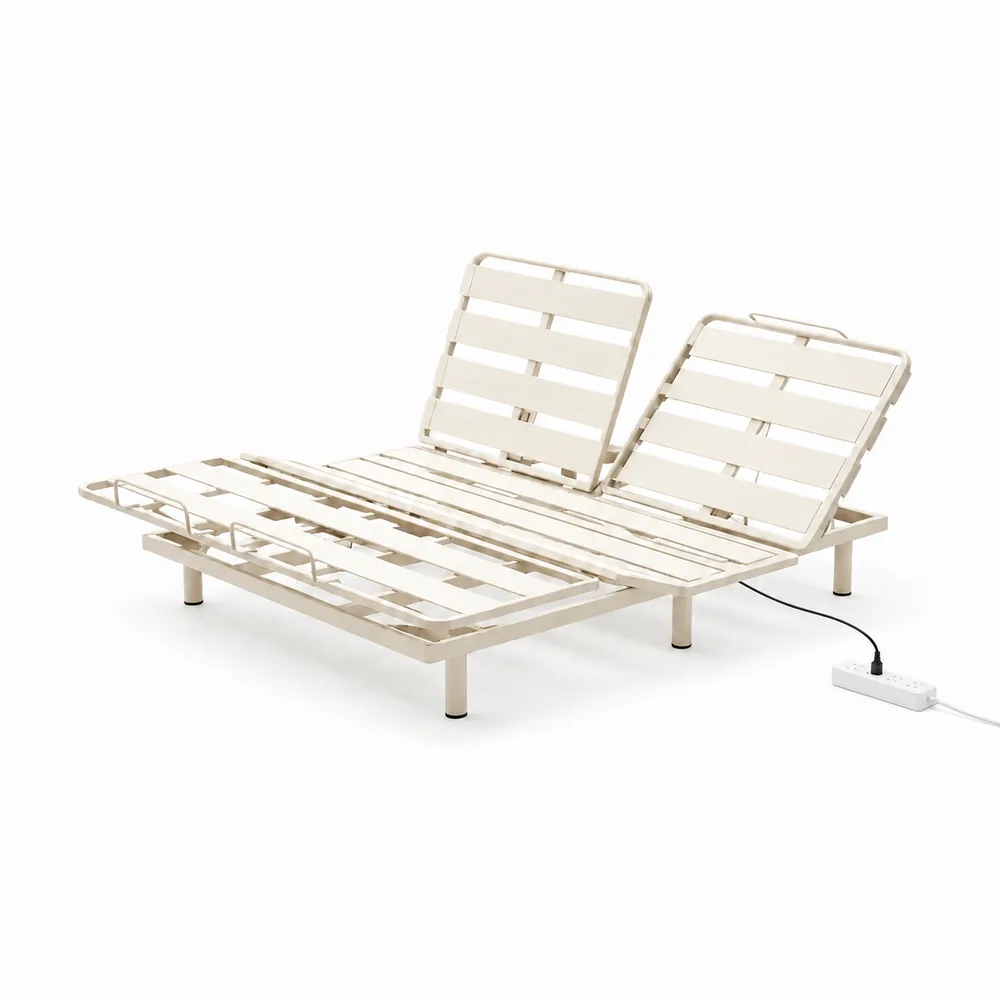
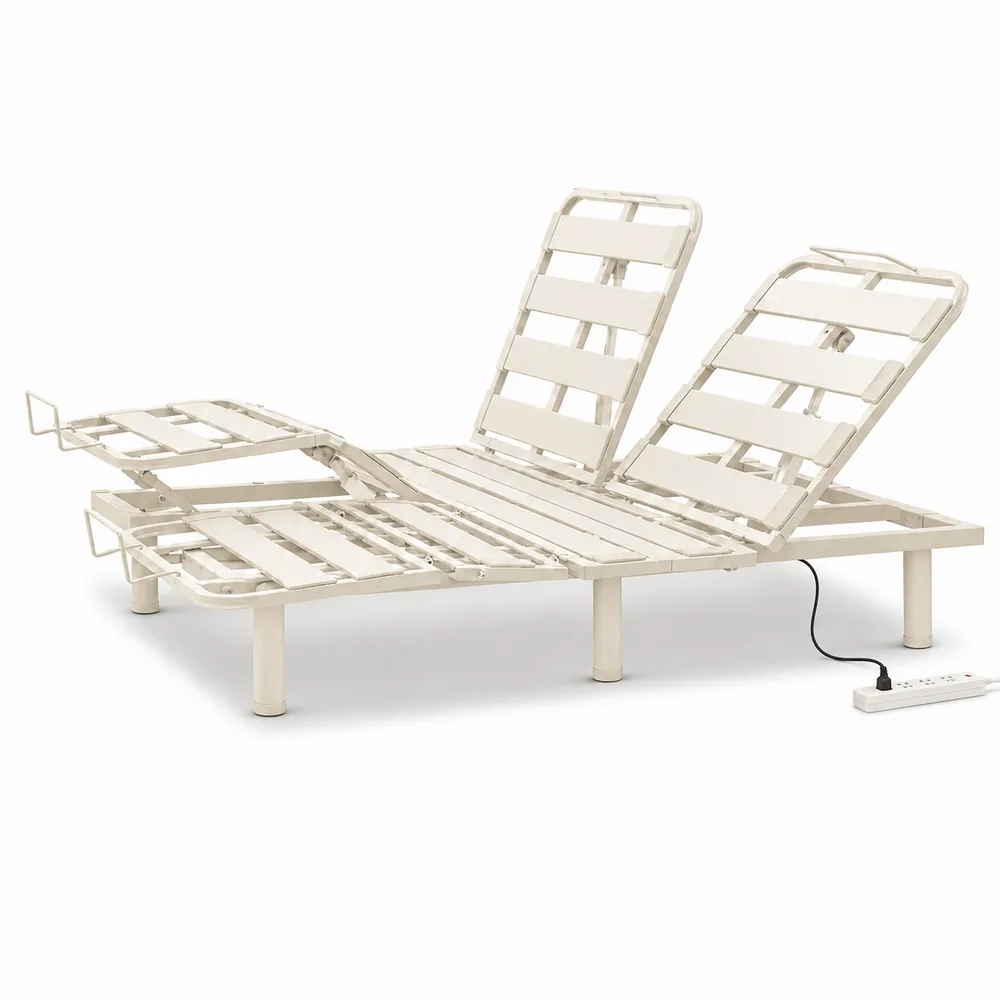
For different upper-body positions, check whether the left and right head/back sections move independently. If leg positions must differ too, check independent head and leg control on each side. The mattress and controls must suit the mechanism; “split” or a motor count alone is insufficient.
Match three layouts to your habits
- Shared motion: both sides of the head section move together, as do both sides of the leg section. This does not mean the head and legs must move simultaneously. Consider it when both sleepers accept the same surface position.
- Independent head sections: each head/back section adjusts separately while the legs remain shared. Consider the situation where one person sits up to read, the other keeps their upper body flat, and both keep their legs flat.
- Full left-right split: each side has independent head and leg adjustment. If one person wants raised legs while the other keeps their entire side flat, check this layout and a compatible mattress arrangement.
These are hypothetical selection examples, not customer case studies. “Head” is a configuration label; consult the movement drawing for the actual back-support area.
Separate positions do not mean zero disturbance
Try operating sound, movement sensations and the centre seam together. If using two separate mattresses, confirm the dimensions, fitted-sheet sizes and pocket depth for each side. Do not assume an existing full-width fitted sheet or thick topper suits independent articulation. No promise is made of silence, an imperceptible seam or improved partner sleep.
Three checks to make together
- Have one person sit up and the other lie flat, then adjust the legs as needed. Check which other zones move.
- Return both sides to flat and try your usual sleeping positions, including how the centre seam feels.
- Confirm each controller's coverage, whether synchronization is supported and how it is selected. Include the mattress, bedding and actual configuration in the quote.
A useful enquiry is: “We need the left side to ____, the right side to ____, and shared / independent leg movement. Please specify the matching structure, mattress arrangement, controls and complete quotation.”
Model information and references
Compare the -3/-4 descriptions with the current SG100 and SP100 information. SH100 also has a different three-actuator head, leg and lumbar layout. Do not confuse these architectures.
The Leggett & Platt official FAQ also discusses separate fitted sheets for split arrangements; its regional mattress-size names do not establish DEPY dimensions. Product source pages reviewed 15 October 2026; external text captured 12 October and reviewed from the archive for this update. Continue with existing-mattress compatibility and the model-selection guide.
The configuration map
| Suffix | Drives | Head section | Leg section | Best understood as |
|---|---|---|---|---|
| -2 | 2 | Full width moves together | Full width moves together | One shared adjustable surface |
| -3 | 3 | Left and right move independently | Shared across the full width | Independent head comfort for two sleepers |
| -4 | 4 | Left and right move independently | Left and right move independently | Two complete movement zones in one bed |
Motor count is not the complete specification
The table above describes DEPY's split codes. SH100 also has a powered-lumbar configuration that uses three OKIN JLDQ.19 actuators for full-width head/back, leg and an independent lumbar section. That is not the same product architecture as the -3 independent-head split.
A buyer should always confirm the movement drawing, functional wording and control layout—not only “three motors.” See the powered lumbar guide for the SH100 layout.
-2: standard shared motion
The standard configuration uses one drive path for the full-width head section and one for the full-width leg section. When the head moves, the complete upper surface changes angle together. The same principle applies to the lower section.
This format is appropriate when unified operation is acceptable, when the product is used by one person, or when a business buyer wants the simplest movement story in the collection.
-3: independent head sections
The head area is divided into left and right sections, each with its own drive. The leg area remains shared. Two sleepers can therefore select different upper-body positions without creating two completely separate lower zones.
This is useful when independent reading or resting positions are more important than fully independent leg movement. Commercial copy should call it “independent head split,” not simply “split,” because the lower section remains shared.
-4: full left-right split
The bed is divided into two movement zones. Each side has an independently controlled head section and leg section. One sleeper's adjustments do not have to determine the other side's position.
The full-split configuration is the clearest choice when a couple wants maximum position independence. It also requires the buyer to confirm how the mattress surface, upholstery, controls and installation should support two complete zones.
Why the drive component matters
All confirmed SG100, SP100 and SH100 configurations use DewertOkin OKIN JLDQ.19 single drives. The technical reference lists a maximum push force of 6,000 N, a no-load speed of 42 mm/s and 24–29 V DC operation. These are component specifications; final bed performance still depends on the complete structure, load, installation and control system.
The confirmed platform articulation ranges are 0–70° at the head and 0–40° at the leg section. Mattress-surface angles can differ slightly because the mattress bends over the moving platform.
How a buyer should choose
- Choose -2 when unified movement is sufficient and simplicity is the priority.
- Choose -3 split when two sleepers need separate upper-body positions but can share leg movement.
- Choose -4 when both sleepers need independent head and leg positioning.
- Choose the SH100 lumbar layout when independent lower-back support matters.
- Confirm the complete functional description in every quotation and purchase order.
The suffix convention is specific to the DEPY product structure described here. Other suppliers may use different naming, and an actuator count alone is never a complete model definition.
Specify the movement before discussing the finish.
Send the required functions, size and quantity; DEPY will map them to the correct layout.
Discuss a configuration